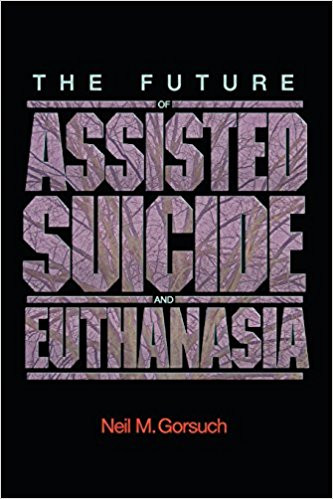
The Future of Assisted Suicide and Euthanasia provides the most thorough overview of the ethical and legal issues raised by assisted suicide and euthanasia--as well as the most comprehensive argument against their legalization--ever published.
In clear terms accessible to the general reader, Neil Gorsuch thoroughly assesses the strengths and weaknesses of leading contemporary ethical arguments for assisted suicide and euthanasia. He explores evidence and case histories from the Netherlands and Oregon, where the practices have been legalized. He analyzes libertarian and autonomy-based arguments for legalization as well as the impact of key U.S. Supreme Court decisions on the debate. And he examines the history and evolution of laws and attitudes regarding assisted suicide and euthanasia in American society.
After assessing the strengths and weaknesses of arguments for assisted suicide and euthanasia, Gorsuch builds a nuanced, novel, and powerful moral and legal argument against legalization, one based on a principle that, surprisingly, has largely been overlooked in the debate--the idea that human life is intrinsically valuable and that intentional killing is always wrong. At the same time, the argument Gorsuch develops leaves wide latitude for individual patient autonomy and the refusal of unwanted medical treatment and life-sustaining care, permitting intervention only in cases where an intention to kill is present.
Those on both sides of the assisted suicide question will find Gorsuch's analysis to be a thoughtful and stimulating contribution to the debate about one of the most controversial public policy issues of our day.
About the Author
Neil M. Gorsuch is an associate justice of the U.S. Supreme Court.
Editorial Reviews
"A thoughtful, sober, and thorough work, which should be read by supporters, opponents, and the undecided alike."--Eugene Volokh, UCLA School of Law
"This may well become one of the most important books in the field. It is timely, thorough, well reasoned, well structured, and well written. Its reply to the arguments for legalizing physician-assisted suicide is measured, fair, and persuasive."--John Keown, Georgetown University, author of Euthanasia, Ethics, and Public Policy
"In a world where there are now many books and articles on assisted suicide and euthanasia, Neil Gorsuch's book is a timely and significant contribution. While the primary focus is on the law, with a systematic survey of pertinent legal and court decisions, the book manages as well to nicely set the problem within a broader international context. His insights and arguments are penetrating and pertinent, and anyone who reads this book will come away with an expanded horizon of understanding."--Daniel Callahan, The Hastings Center, author of The Research Imperative: What Price Better Health?
"Gorsuch's book is an exceptionally fine contribution to one of the most timely debates in ethics and public policy: the question of assisted suicide and voluntary euthanasia. It sorts out the arguments for and against relaxing legal prohibitions on choices of these kinds, and does so in tandem with an account--close, accurate, straightforward, and uncluttered--of the developing law in statutes and cases. It could quickly become the leading book in the field."--Robert P. George, Princeton University, and the President's Commission on Bioethics
Commendation Quotes:
In a world where there are now many books and articles on assisted suicide and euthanasia, Neil Gorsuch's book is a timely and significant contribution. While the primary focus is on the law, with a systematic survey of pertinent legal and court decisions, the book manages as well to nicely set the problem within a broader international context. His insights and arguments are penetrating and pertinent, and anyone who reads this book will come away with an expanded horizon of understanding.
Review Quotes:
The author provides a thorough overview of the ethical and legal issues raised by assisted suicide and euthanasia, as well as the most comprehensive argument against their legalization. -- Issues in Law & Medicine
Review Quotes:
Gorsuch reviews the case law and the range of ethical and legal issues surrounding assisted suicide and offers a strong argument against legalization of these practices, even as he considers both positions in the debate. -- Law & Social Inquiry
Review Quotes:
Neil M. Gorsuch builds a powerful moral and legal argument against [assisted suicide's] legalization, one based on a principle that has largely been overlooked in the debate--the idea that human life is intrinsically valuable and that intentional killing is wrong. -- New Oxford Review
Review Quotes:
The author provides a thorough overview of the ethical and legal issues raised by assisted suicide and euthanasia, as well as the most comprehensive argument against their legalization. -- "Issues in Law & Medicine
Review Quotes:
Gorsuch reviews the case law and the range of ethical and legal issues surrounding assisted suicide and offers a strong argument against legalization of these practices, even as he considers both positions in the debate. -- "Law & Social Inquiry
Review Quotes:
Neil M. Gorsuch builds a powerful moral and legal argument against [assisted suicide's] legalization, one based on a principle that has largely been overlooked in the debate--the idea that human life is intrinsically valuable and that intentional killing is wrong. -- "New Oxford Review
Review Quotes:
I believe that anyone who is concerned about the issue must engage with [Gorsuch's] arguments.--Raymond Tallis "Times Literary Supplement "
Review Quotes:
Thoroughly researched. . . . Gorsuch is especially successful when exploring the relevant legal cases raised by assisted-suicide and euthanasia advocacy.--Wesley J. Smith "First Things "
Review Quotes:
Goruch's book is an exceptional contribution to a debate that is both significant and topical. Every reader, whether or not ultimately persuaded by his arguments, will emerge better equipped to tackle the profound questions surrounding euthanasia and assisted suicide. it is essential reading for advocates and opponents alike.--Wendy E. Hiscox "Studies in Christian Ethics "
Review Quotes:
Gorsuch lucidly lays out the key ethical and philosophical arguments on both sides. . . . [This] is the most important book published so far in consideration of ethical and legal issues.--Kevin Yuill "Spiked Review of Books "
Review Quotes:
For those who need insight into the part played by legislators and courts of justice in recent euthanasia discussions, Neil M. Gorsuch's book . . . is an excellent source. . . . [C]omprehensive and well argued.--Theo A. Boer "Journal of Religious Ethics "
Review Quotes:
I believe that anyone who is concerned about the issue must engage with [Gorsuch's] arguments.
--Raymond Tallis "Times Literary Supplement "
Review Quotes:
Gorsuch lucidly lays out the key ethical and philosophical arguments on both sides. . . . [This] is the most important book published so far in consideration of ethical and legal issues.
--Kevin Yuill "Spiked Review of Books "
Review Quotes:
For those who need insight into the part played by legislators and courts of justice in recent euthanasia discussions, Neil M. Gorsuch's book . . . is an excellent source. . . . [C]omprehensive and well argued.
--Theo A. Boer "Journal of Religious Ethics "
Review Quotes:
Thoroughly researched. . . . Gorsuch is especially successful when exploring the relevant legal cases raised by assisted-suicide and euthanasia advocacy.
--Wesley J. Smith "First Things "
Review Quotes:
Goruch's book is an exceptional contribution to a debate that is both significant and topical. Every reader, whether or not ultimately persuaded by his arguments, will emerge better equipped to tackle the profound questions surrounding euthanasia and assisted suicide. it is essential reading for advocates and opponents alike.
--Wendy E. Hiscox "Studies in Christian Ethics "
Review Quotes:
"I believe that anyone who is concerned about the issue must engage with [Gorsuch's] arguments." --Raymond Tallis, Times Literary Supplement
Review Quotes:
"Gorsuch lucidly lays out the key ethical and philosophical arguments on both sides. . . . [This] is the most important book published so far in consideration of ethical and legal issues." --Kevin Yuill, Spiked Review of Books
Review Quotes:
"The author provides a thorough overview of the ethical and legal issues raised by assisted suicide and euthanasia, as well as the most comprehensive argument against their legalization." --Issues in Law & Medicine
Review Quotes:
"Gorsuch reviews the case law and the range of ethical and legal issues surrounding assisted suicide and offers a strong argument against legalization of these practices, even as he considers both positions in the debate." --Law & Social Inquiry
Review Quotes:
"For those who need insight into the part played by legislators and courts of justice in recent euthanasia discussions, Neil M. Gorsuch's book . . . is an excellent source. . . . [C]omprehensive and well argued." --Theo A. Boer, Journal of Religious Ethics
Review Quotes:
"Neil M. Gorsuch builds a powerful moral and legal argument against [assisted suicide's] legalization, one based on a principle that has largely been overlooked in the debate--the idea that human life is intrinsically valuable and that intentional killing is wrong." --New Oxford Review
Review Quotes:
"Thoroughly researched. . . . Gorsuch is especially successful when exploring the relevant legal cases raised by assisted-suicide and euthanasia advocacy." --Wesley J. Smith, First Things
Review Quotes:
"Goruch's book is an exceptional contribution to a debate that is both significant and topical. Every reader, whether or not ultimately persuaded by his arguments, will emerge better equipped to tackle the profound questions surrounding euthanasia and assisted suicide. it is essential reading for advocates and opponents alike." --Wendy E. Hiscox, Studies in Christian Ethics
Review Quotes:
-I believe that anyone who is concerned about the issue must engage with [Gorsuch's] arguments.- --Raymond Tallis, Times Literary Supplement
Review Quotes:
-Gorsuch lucidly lays out the key ethical and philosophical arguments on both sides. . . . [This] is the most important book published so far in consideration of ethical and legal issues.- --Kevin Yuill, Spiked Review of Books
Review Quotes:
-The author provides a thorough overview of the ethical and legal issues raised by assisted suicide and euthanasia, as well as the most comprehensive argument against their legalization.- --Issues in Law & Medicine
Review Quotes:
-Gorsuch reviews the case law and the range of ethical and legal issues surrounding assisted suicide and offers a strong argument against legalization of these practices, even as he considers both positions in the debate.- --Law & Social Inquiry
Review Quotes:
-For those who need insight into the part played by legislators and courts of justice in recent euthanasia discussions, Neil M. Gorsuch's book . . . is an excellent source. . . . [C]omprehensive and well argued.- --Theo A. Boer, Journal of Religious Ethics
Review Quotes:
-Neil M. Gorsuch builds a powerful moral and legal argument against [assisted suicide's] legalization, one based on a principle that has largely been overlooked in the debate--the idea that human life is intrinsically valuable and that intentional killing is wrong.- --New Oxford Review
Review Quotes:
-Thoroughly researched. . . . Gorsuch is especially successful when exploring the relevant legal cases raised by assisted-suicide and euthanasia advocacy.- --Wesley J. Smith, First Things
Review Quotes:
-Goruch's book is an exceptional contribution to a debate that is both significant and topical. Every reader, whether or not ultimately persuaded by his arguments, will emerge better equipped to tackle the profound questions surrounding euthanasia and assisted suicide. it is essential reading for advocates and opponents alike.- --Wendy E. Hiscox, Studies in Christian Ethics
Review Quotes:
"Justice Gorsuch's first published monograph is a philosophically informed argument for the inherent dignity of human life. His prose is clear, his insight powerful. They demonstrate a prescient understanding of the direction the law may go in the end-of-life debate." --Christopher J. Wolfe, National Catholic Bioethics Quarterly
Table of Contents:
Chapter 1: Introduction 1
Chapter 2: The Glucksberg and Quill Controversies: The Judiciary's (Non)Resolution of the Assisted Suicide Debate 8
2.1 The Washington Due Process Litigation 8
2.2 The New York Equal Protection Litigation 11
2.3 The Final Battle? The Supreme Court Does (and Does Not) Decide 14
2.4 The Aftermath of Glucksberg and Quill 17
Chapter 3: The Debate over History 19
3.1 Which History? 20
3.2 The Project 22
3.3 The Ancients 22
3.4 Early Christian History 25
3.5 English Common Law 28
3.6 Colonial American Experience 29
3.7 The Modern Consensus on Suicide and Its Assistance 30
3.8 The Euthanasia Movement 33
3.9 Prevailing Law Today 43
3.10 Conclusion 46
Chapter 4: Arguments from Fairness and Equal Protection: If a Right to Refuse, Then a Right to Assisted Suicide? 48
4.1 An Act /Omission Distinction? 49
4.2 A Causation-Based Distinction? 51
4.3 Toward an Intent-Based Distinction: The Insight of the Double Effect Principle 53
4.4 Some (Initial) Arguments against Double Effect: Conflating Intent and Foresight 57
4.5 Distinguishing Suicide, Assisted Suicide, and Euthanasia from the Right to Refuse: Intending versus Foreseeing Death 62
4.6 Some (Additional) Criticisms of Double Effect as Applied to the Assisted Suicide Debate 69
4.7 Conclusion 75
Chapter 5: Casey and Cruzan: Do They Intimate a Right to Assisted Suicide and Euthanasia? 76
5.1 The "Reasoned Judgment" Test and Its Critics 76
5.2 Casey-Based Arguments 79
5.3 Cruzan-Based Arguments 82
5.4 Conclusion 84
Chapter 6: Autonomy Theory's Implications for the Debate over Assisted Suicide and Euthanasia 86
6.1 The Autonomy Debate 86
6.2 The Neutralist View of Autonomy 87
6.3 The Harm Principle's Competing View 89
6.4 Perfectionism and Autonomy 90
6.5 The Implications of Autonomy Theory for the Assisted Suicide and Euthanasia Debate 93
Chapter 7: Legalization and the Law of Unintended Consequences: Utilitarian Arguments for Legalization 102
7.1 The Dutch Experience: "Virtually Abuse-Free"? 103
7.2 The Oregon Experience: An "All-Too Conscientious" Statutory Regime? 115
7.3 Legalization and Other Unintended Consequences 125
7.4 Decriminalization as a "Costless" Enterprise? 132
7.5 How to "Balance" the Costs and Benefits of Legalization? 138
7.6 Conclusion 141
Chapter 8: Two Test Cases: Posner and Epstein 143
8.1 Posner's Utilitarian Case for Assisted Suicide 143
8.2 Posner's and Epstein's Libertarian Case for Assisted Suicide 152
Chapter 9: An Argument against Legalization 157
9.1 The Inviolability of Human Life 157
9.2 What Does It Mean to Respect Human Life as a Basic Good? 163
9.3 Some Objections 167
9.4 The Future of the Oregon Experiment? 176
Chapter 10: Toward a Consistent End-of-Life Ethic: The "Right to Refuse" Care for Competent and Incompetent Patients 181
10.1 The Inviolability of Life and the "Right to Refuse" for Competent Persons 182
10.2 The "Right to Refuse" and Infant Patients 191
10.3 The "Right to Refuse" and Incompetent Adult Patients 204
10.4 Conclusions 215
Epilogue 219
Appendix A: Certain American Statutory Laws Banning or Disapproving of Assisted Suicide 227
Appendix B: Statistical Calculations 229
Notes 231
Bibliography 285
Index 303
| Dimensions 2.29 cms H x 23.11 cms L x 15.49 cms W |